

MAS Technology Risk Management Amendments 2026
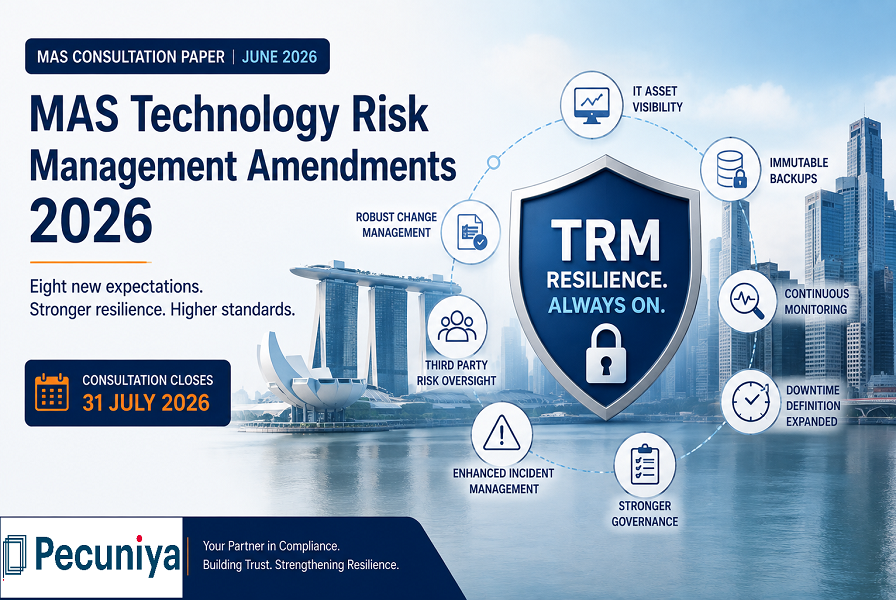
In June 2026, the Monetary Authority of Singapore (MAS) released a consultation paper proposing the MAS Technology Risk Management amendments, a set of changes that could reshape how financial institutions manage technology risk. This is not a single headline change. Instead, the amendments touch eight distinct areas of technology risk governance, ranging from IT asset visibility to how firms account for system downtime.
For compliance officers, technology risk managers, and boards, this update deserves a close read rather than a quick skim. The proposal signals where MAS expects the industry to move next. Institutions that start preparing now will gain a real head start once the amendments take effect. Below, we break down what MAS proposes, why it matters, and what practical steps to take before the consultation window closes.
📥 Download the complete MAS TRM Amendments here: Pecuniya Regulatory Updates June 2026
Executive Summary
- MAS released a consultation paper on 26 June 2026, setting out the MAS Technology Risk Management amendments to its Notices on Technology Risk Management.
- The proposal spans eight areas: IT asset visibility, risk framework maturity, capacity planning, change management, continuous monitoring, backup resilience, incident management, and downtime classification.
- Together, the changes point to one expectation: technology risk management should run continuously and carry clear evidence, rather than function as a periodic checkbox exercise.
- The consultation window closes on 31 July 2026.
- Institutions should begin benchmarking their current posture against the eight areas now, regardless of when MAS confirms the final rules.
Why This Regulatory Update Matters
The Driver Behind the Consultation
MAS issues consultation papers when it sees a gap between how the industry currently operates and where the risk environment is heading. Here, the driver is explicit: an evolving threat landscape that artificial intelligence and other advanced capabilities increasingly shape.
That context matters for how you read the proposal. This is not a routine tidy-up of existing rules. Instead, the MAS Technology Risk Management amendments raise the regulatory baseline for the sector, responding to attackers who are faster, better resourced, and increasingly able to exploit gaps that older TRM frameworks never anticipated.
Who This Affects
This proposal affects every financial institution operating in Singapore that falls under MAS’s existing TRM Notices. That includes banks, payment service providers, insurers, capital markets intermediaries, and other regulated entities whose IT systems support critical business functions.
The Problem MAS Is Addressing
At its core, MAS is targeting fragmented technology risk practices: incomplete asset inventories, risk assessments that happen annually rather than continuously, and downtime reporting that misses the full picture of service disruption. If institutions leave these gaps unaddressed, both attackers and auditors can exploit them.
Key MAS Technology Risk Management Amendments
The consultation paper proposes that financial institutions demonstrate eight specific capabilities as part of their TRM obligations.
| # | Proposed Requirement Area | What It Means in Practice |
| 1 | Complete IT asset visibility | A current, accurate inventory covering every IT asset, with no blind spots |
| 2 | A living IT risk framework | Ongoing risk assessments, a maintained risk register, and defined key risk indicators |
| 3 | Forward-looking capacity planning | A structured process for capacity planning across all critical systems |
| 4 | Disciplined change management | System changes moved through a controlled, governed process end to end |
| 5 | Always-on monitoring | Continuous performance and security monitoring with prompt remediation |
| 6 | Resilient, immutable backups | Offline and/or immutable backup capability for fast, confident recovery |
| 7 | Structured incident management | A defined framework covering detection through resolution |
| 8 | Broader downtime accounting | Unscheduled downtime calculations must capture partial and intermittent disruptions, not just full outages |
Before vs. After: How Practices Would Shift
| Area | Common Current Practice | Direction Under Proposed Amendments |
| Asset inventory | Periodic manual updates, gaps common | Continuous, complete, and accurate visibility |
| Risk assessment | Annual or ad hoc reviews | Ongoing discipline with live risk register and KRIs |
| Monitoring | Scheduled checks, alert-driven | Continuous monitoring of critical systems |
| Backups | Standard backup routines | Offline and/or immutable backups required |
| Downtime tracking | Full outages only | Partial and intermittent disruptions included |
Detailed Analysis
1. IT Asset Visibility
MAS proposes that institutions maintain a complete, accurate, and current inventory of every IT asset in their environment. You cannot secure or monitor what you don’t know exists. In practice, institutions running legacy infrastructure alongside newer digital platforms often carry undocumented or “shadow” assets that fall outside formal inventories — precisely the blind spot this requirement targets.
2. A Living IT Risk Framework
Rather than a once-a-year risk assessment exercise, MAS wants risk assessments, a maintained risk register, and defined key risk indicators (KRIs) working together as an ongoing discipline. In practice, this means teams actively update risk registers as the environment changes, instead of dusting off documents before an audit.
3. Forward-Looking Capacity Planning
Institutions would need a structured process for capacity planning across systems that are critical to operations. This addresses a common cause of outages: systems that fail under load because capacity planning was reactive rather than anticipatory.
4. Disciplined Change Management
System changes — from minor configuration updates to major platform changes — would need to move through a controlled, properly governed process from proposal through implementation. This reduces the risk that unauthorised or poorly tested changes trigger outages or security gaps.
5. Always-On Monitoring
This proposal would make continuous performance and security monitoring, combined with prompt remediation, an expected baseline for critical systems rather than just a best practice. This reflects the reality that threat actors operate continuously, so defensive monitoring needs to as well.
6. Resilient, Immutable Backups
Offline and/or immutable backups let institutions restore services quickly after an incident, including ransomware, where attackers frequently target backups first. This requirement assumes that compromise is a matter of when, not if.
7. Structured Incident Management
Institutions would need a defined framework and process for managing IT incidents from detection through resolution, rather than ad hoc handling that varies by team or severity.
8. Broader Downtime Accounting
Perhaps the most operationally significant change is this: unscheduled downtime calculations would need to capture partial and intermittent disruptions, not only full outages. Institutions that have historically tracked only complete system failures will need to redefine how they monitor and report downtime events.
Business Impact
Across every dimension below, the MAS Technology Risk Management amendments carry direct consequences for how institutions operate, budget, and report.
- Operational impact: Teams will need to formalize processes — asset inventories, capacity planning, change governance — that they may currently handle informally or inconsistently across business units.
- Compliance impact: Compliance and risk functions will need updated evidence trails to demonstrate ongoing, not periodic, adherence to TRM expectations.
- Technology impact: IT teams may need to invest in tooling for continuous asset discovery, monitoring, and immutable backup infrastructure.
- Governance impact: Boards and senior management will likely face increased oversight expectations, since MAS wants firms to embed TRM into day-to-day operations.
- Financial impact: Institutions relying on legacy systems or manual processes should budget for tooling and process investment ahead of any final implementation timeline.
- Risk impact: Because the proposal redefines downtime to include partial disruptions, institutions may see more reportable incidents — which means recalibrating internal thresholds and escalation paths.
- Customer impact: Ultimately, stronger resilience requirements aim to reduce service disruption for customers, though implementation periods may bring short-term operational adjustments.
Top 10 Common Mistakes
- Treating this as a distant deadline. The consultation closes on 31 July 2026, but final rules and implementation timelines will likely follow. Waiting for finality before acting simply means starting remediation late.
- Relying on informal asset knowledge. Many institutions believe their inventory is complete because “the team knows the environment.” Yet undocumented assets are exactly what this proposal targets.
- Confusing annual risk reviews with a living framework. A risk register updated once a year does not meet the spirit of “ongoing discipline” that MAS describes.
- Underestimating the downtime redefinition. Institutions that only track full outages may undercount incidents once partial and intermittent disruptions count too.
- Assuming backups are sufficient without testing restoration. Having a backup differs from being able to restore quickly and confidently — so test the process, not just the existence of backups.
- Leaving change management informal for “minor” changes. Small, ungoverned changes are a frequent source of outages and security gaps.
- Siloing incident management by team. Inconsistent incident handling across business units undermines the structured, defined framework MAS expects.
- Skipping the consultation response process. Institutions that engage with MAS during consultation windows can help shape practical, workable final rules.
- Failing to brief the board early. Governance impact is real, so leaders should brief the board early — otherwise, resourcing needs may come as a late surprise.
- Treating this as an IT-only issue. Technology risk management spans compliance, risk, operations, and governance, so cross-functional ownership matters.
Expert Recommendations
The following are Pecuniya’s expert analysis and industry best-practice recommendations. They are not official MAS requirements and should be read as practical guidance based on professional compliance experience.
- Start with a structured gap assessment against the eight proposed areas before waiting for final rules. This creates a defensible starting point regardless of how MAS ultimately words the final Notice.
- Prioritize backup resilience and continuous monitoring first, since these tend to require the longest lead time for tooling and infrastructure investment.
- Recalibrate your downtime reporting definitions now, because this change affects historical trend reporting and internal escalation thresholds.
- Treat the consultation response as an opportunity, not just a compliance formality. Institutions that raise practical implementation concerns can help shape workable final requirements.
- Build cross-functional ownership across compliance, IT, and risk from the outset, rather than assigning this solely to the technology function.
Frequently Asked Questions
What are the MAS Technology Risk Management amendments about?
The MAS Technology Risk Management amendments propose changes across eight areas, covering asset visibility, risk frameworks, monitoring, backups, and downtime reporting.
Which institutions are affected?
The proposal affects financial institutions operating in Singapore that fall under MAS’s existing TRM Notices, including banks, payment service providers, and other regulated entities.
Is this already a confirmed rule?
No. It is currently a consultation paper, and MAS is seeking feedback before finalizing any amendments.
What is the biggest operational change proposed?
The redefinition of unscheduled downtime to include partial and intermittent disruptions, not only full outages, stands out as one of the most operationally significant changes.
Why is MAS proposing these changes now?
MAS points to a threat landscape that artificial intelligence and other advanced capabilities increasingly shape, and cites this as the driver for raising the regulatory baseline.
What does “immutable backups” mean in this context?
It refers to backup data that no one can alter or delete within a set period, which protects recovery capability even if attackers compromise primary systems, such as in a ransomware attack.
How should institutions respond to the consultation?
Institutions and interested parties can submit feedback to MAS through the official consultation channel on the MAS website before the 31 July 2026 deadline.
What should compliance teams do first?
Compliance teams should read the full consultation paper, assign internal ownership, and begin a gap assessment against the eight proposed requirement areas.
Does this affect smaller fintech firms as well as large banks?
The proposal applies to institutions falling under MAS’s existing TRM Notices, so institutions should confirm scope and applicability against their specific licensing category.
How does this relate to Business Continuity Management (BCM)?
The proposed incident management and backup resilience requirements closely intersect with existing BCM obligations, including recovery time and recovery point objectives.
What happens after the consultation closes?
MAS will review feedback before finalizing the amendments, and institutions should expect a defined implementation timeline once MAS confirms the rules.
Where can I read the full consultation paper?
View the MAS consultation paper here.
Conclusion
The MAS Technology Risk Management amendments send a clear signal, not a minor technical update. Across eight areas — from asset visibility to downtime classification — the direction is the same: technology risk management must run continuously, carry clear evidence, and sit inside daily operations.
Institutions that treat this as an early warning, rather than a future problem, will gain a stronger position once MAS finalizes the amendments. In short, that means starting the gap assessment now, prioritizing the areas with the longest implementation lead time, and making sure the board understands both the requirements and the resourcing they imply.
How Pecuniya Can Help
Reviewing eight areas of technology risk governance against your current environment is a significant undertaking, particularly alongside day-to-day compliance obligations. That’s why Pecuniya Compliance Solutions works with MAS-regulated institutions to make that process practical and manageable.
Specifically, our team can support your institution with:
- Audit Readiness Assessment — benchmarking your current TRM posture against the eight proposed requirement areas
- Gap Analysis — identifying where your existing frameworks fall short of the proposed changes
- Compliance Advisory — practical guidance on risk registers, KRIs, and governance documentation
- Technology Risk Review — assessing monitoring, backup, and incident management capability
- AML/CFT Review — ensuring alignment across your broader regulatory obligations
- Internal Audit — independent verification of your readiness ahead of implementation
With over 20 years of experience supporting MAS-regulated entities, Pecuniya helps institutions turn regulatory change into a structured, manageable process rather than a last-minute scramble.
Ready to assess where your institution stands? Visit www.pecuniya.com/get-a-quote to speak with our team.
Leave a Reply