

MAS BCM Audit Readiness Guide for Financial Institutions
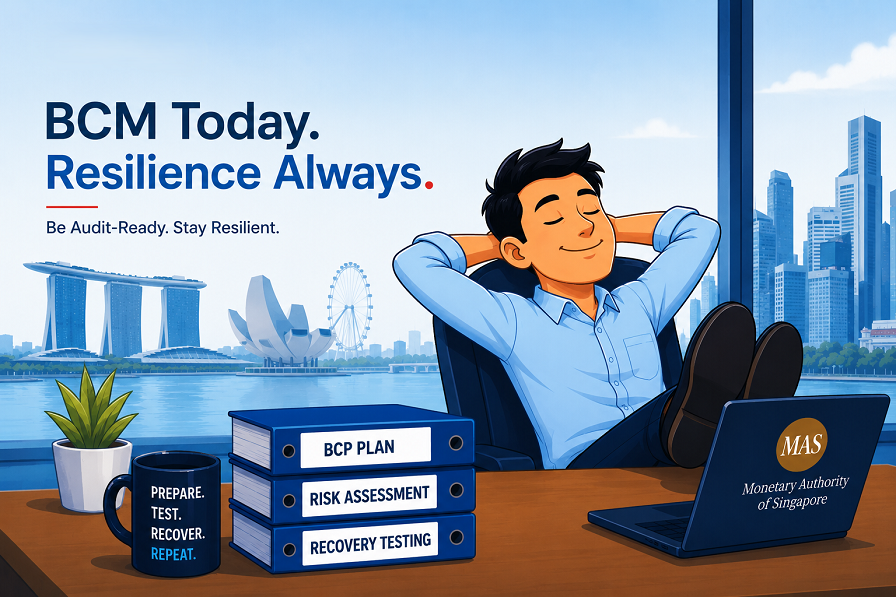
For financial institutions regulated by the Monetary Authority of Singapore, the clock is ticking on the next Business Continuity Management audit cycle. The June 2027 deadline may feel distant — but those who start preparing today will be the ones who sail through it.
A MAS Business Continuity Management audit is not simply a compliance checkpoint. It is a structured assessment of whether a financial institution can keep delivering critical business services when things go wrong — during a cyberattack, a cloud outage, a pandemic, or the sudden loss of a key vendor.
Under the MAS Guidelines on Business Continuity Management (June 2022), all regulated financial institutions completed their inaugural independent BCM audit by 6 June 2024. With MAS mandating a new audit once every three years, the next compliance milestone is locked in for 6 June 2027 — or three years from whichever date your most recent BCM audit was concluded.
Building Operational Resilience Beyond Audit Day
At Pecuniya, we have seen first-hand what separates institutions that thrive during a BCM audit from those scrambling to remediate at the last minute. The answer is almost always preparation — specifically, building Business Continuity Management into the day-to-day fabric of operations rather than treating it as a periodic exercise.
Many financial institutions begin preparing for a BCM audit only after receiving an audit notification. Recovery plans are updated, testing evidence is collected, contact lists are refreshed, and documentation is hurriedly compiled.
While this approach may help assemble audit evidence, it does little to strengthen an organization’s ability to withstand real operational disruptions.
A ransomware attack, prolonged cloud outage, telecommunications failure, pandemic, cyber incident, third-party service disruption, or loss of critical personnel rarely provides advance notice. Organizations that rely on last-minute preparations often discover that documented procedures do not reflect operational reality.
This is precisely why MAS places significant emphasis on Business Continuity Management. Rather than treating BCM as a compliance exercise, MAS expects financial institutions to embed resilience into day-to-day operations, ensuring that critical business services remain available during disruptions.
MAS BCM Audit Readiness
For MAS-regulated entities — including banks, digital banks, insurers, payment institutions, capital markets intermediaries, licensed fund management companies (LFMCs), and FinTech firms — BCM is a fundamental component of sound governance, operational resilience, and risk management.
The organizations that consistently perform well during regulatory inspections are rarely those with the largest BCM manuals. They are the ones that continuously review, test, improve, and demonstrate resilience throughout the year — not just before an audit.
This guide explores the regulatory expectations under the MAS Guidelines on Business Continuity Management, the most common BCM audit findings, and the practical steps financial institutions can take to strengthen BCM maturity and build sustainable operational resilience.
What is Business Continuity Management under MAS?
Business Continuity Management (BCM) is a governance and operational resilience framework that enables MAS-regulated financial institutions to continue delivering critical business services during disruptions. The MAS Guidelines on Business Continuity Management (June 2022) expect firms to establish recovery strategies, conduct Business Impact Analyses, perform regular testing, and continuously improve resilience capabilities.
Why Business Continuity Management Matters More Than Ever
Financial services have become increasingly interconnected. A disruption affecting one organization can quickly cascade through payment systems, cloud service providers, outsourcing partners, and market infrastructure.
Several trends have amplified operational risk across the financial sector:
- Increasing reliance on cloud technologies
- Greater dependence on third-party service providers
- Sophisticated cyber threats and cyber resilience demands
- Hybrid and remote working models
- Cross-border operations
- Digital banking and always-on customer expectations
- Growing regulatory scrutiny of operational resilience, in line with Basel Committee publications on operational resilience
These developments mean that maintaining service availability is no longer solely an IT responsibility. Business continuity now requires coordinated planning across technology, operations, compliance, risk management, business units, vendors, and senior management.
Customers expect uninterrupted access to financial services. Regulators expect institutions to demonstrate resilience under severe but plausible disruption scenarios. Boards expect operational risks to be understood, measured, and managed proactively.
Business Continuity Management therefore becomes an organization-wide capability rather than an isolated compliance program.
MAS Expectations for Business Continuity Management
The MAS Guidelines on Business Continuity Management (June 2022) outline supervisory expectations for financial institutions to establish, maintain, and continually improve their BCM framework.
The guidelines encourage institutions to move beyond maintaining documentation and instead demonstrate that critical business services can continue operating during significant disruptions.
Key areas of regulatory focus include:
1. Governance and Accountability
Senior management and the Board are expected to provide oversight of BCM, approve strategies, allocate sufficient resources, and ensure resilience objectives align with the institution’s overall risk appetite.
Key Point: Effective BCM begins with strong governance rather than documentation alone.
2. Identification of Critical Business Services
Institutions should identify services whose disruption could significantly impact:
- Customers
- Financial stability
- Regulatory obligations
- Market confidence
- Business operations
Best Practice: Conduct a structured Business Impact Analysis (BIA) that identifies critical processes, supporting applications, people, facilities, vendors, and technology dependencies.
3. Recovery Objectives
MAS expects organizations to establish measurable recovery objectives, including:
- Recovery Time Objectives (RTOs)
- Recovery Point Objectives (RPOs)
- Maximum Tolerable Downtime
- Service Recovery Time Objectives (SRTOs) for each critical business service
- Service recovery priorities
Best Practice: Recovery objectives should be realistic, tested, and aligned with business impact assessments.
4. Business Continuity Plans
Business Continuity Plans should be practical, current, and actionable.
Rather than generic documentation, effective plans clearly define:
- Response procedures
- Escalation paths
- Decision authorities
- Crisis management roles
- Communication protocols
- Recovery activities
- Alternative operating arrangements
Best Practice: Plans should remain accessible during disruptions and reflect current business operations.
5. Testing and Exercising
One of the strongest indicators of BCM maturity is regular testing.
MAS expects institutions to conduct periodic exercises that validate whether continuity strategies work in practice.
BCM testing may include:
- Tabletop exercises
- Technical recovery testing
- Disaster recovery exercises
- Crisis management simulations
- Communication testing
- Third-party participation
- End-to-end operational scenarios
Best Practice: Testing outcomes should drive continual improvement rather than simply satisfy annual compliance requirements.
6. Third-Party Dependency Management
Financial institutions increasingly rely on outsourcing providers, cloud service providers, telecommunications companies, payment processors, and software vendors.
MAS expects organizations to understand these dependencies — in line with the MAS Outsourcing Guidelines — and assess whether external service providers can continue supporting critical services during disruptions.
Third party risk and dependency mapping have therefore become a central element of modern BCM programs. Where third parties hold an ISO 22301 Business Continuity Management Systems certification, this can support — but does not replace — an FI’s own assurance over critical third-party services.
Best Practice: Assess whether external service providers can continue supporting critical services during disruptions — third-party certification supports, but does not replace, an FI’s own assurance.
7. Continuous Improvement
Business Continuity Management is not static.
Institutions should periodically review and update:
- Business Impact Analyses
- Recovery strategies
- Contact information
- Vendor inventories
- Recovery procedures
- Crisis communication plans
- Testing scenarios
Best Practice: Continuous improvement ensures BCM remains aligned with organizational changes and evolving risks.
Common BCM Audit Findings
Across MAS-regulated financial institutions, certain BCM audit findings surface repeatedly. Recognizing these patterns early allows institutions to close gaps before — not during — an audit.
Common observations include:
- Outdated Business Impact Analyses that no longer reflect current business processes, systems, or organizational structure
- Recovery Time Objectives that have never been tested, leaving institutions unable to demonstrate whether recovery targets are achievable
- Business Continuity Plans that are difficult to execute, with vague escalation paths or unclear decision authorities
- Incomplete third-party dependency mapping, particularly for cloud providers, outsourced functions, and critical software vendors
- Limited evidence of testing outcomes being translated into corrective action
- Inconsistent crisis communication protocols across business units
- Governance gaps, where the Board receives high-level BCM reporting without sufficient detail to exercise effective oversight
- Concentration risk left unaddressed, such as reliance on a single data center, zone, or service provider
Each of these findings points back to the same underlying issue: documentation that has drifted away from operational reality.
Quick Answer: What are common BCM audit findings? The most common findings are outdated Business Impact Analyses, untested Recovery Time Objectives, Business Continuity Plans that are difficult to execute, incomplete third-party dependency mapping, limited follow-through on testing outcomes, inconsistent crisis communication, governance gaps, and unaddressed concentration risk.
Risk Implications of Weak BCM
A weak BCM framework is not merely an audit risk — it is an operational and reputational risk.
Institutions with immature BCM capabilities face heightened exposure to:
- Extended service outages that breach recovery objectives and erode customer trust
- Regulatory scrutiny and supervisory action, including more intensive MAS engagement following adverse findings
- Financial loss arising from failed transactions, breached service level agreements, or contractual penalties
- Reputational damage, particularly where disruptions affect customer-facing services
- Contagion risk, given how interconnected payment systems, market infrastructure, and outsourcing arrangements have become
- Board and senior management accountability gaps, where oversight failures come under direct regulatory attention
Weak Business Continuity Management rarely stays contained. It tends to surface — often publicly — at the worst possible moment.
Building a Mature BCM Program
A mature BCM program treats resilience as a continuous capability rather than a periodic compliance task. In practice, this means:
- Embedding BCM ownership within business units, not just a central risk or compliance function
- Conducting a BCM gap analysis against MAS expectations and recognized standards such as ISO 22301
- Maintaining a live inventory of critical business services, dependencies, and third parties
- Running a structured Business Impact Analysis review at least annually, or whenever there is a material change to business operations
- Conducting realistic, scenario-based testing — not just procedural walkthroughs
- Reporting meaningful BCM metrics to the Board, rather than status updates alone
- Treating every testing exercise, near-miss, or actual incident as an input for continuous improvement
Maturity is demonstrated through evidence of practice, not the thickness of a policy document.
BCM Implementation Roadmap
For institutions strengthening their BCM program ahead of the next audit cycle, a phased roadmap typically includes:
- Assess — Conduct a BCM gap analysis against the MAS Guidelines on Business Continuity Management and your most recent audit findings.
- Map — Update the Business Impact Analysis and dependency mapping for all critical business services, including third parties.
- Define — Set or revalidate Recovery Time Objectives, Recovery Point Objectives, and Service Recovery Time Objectives.
- Document — Refresh Business Continuity Plans so they reflect actual operating procedures, escalation paths, and contact details.
- Test — Run tabletop exercises, technical recovery tests, and crisis management simulations across the year, not only before an audit.
- Review — Translate testing outcomes and incident learnings into concrete remediation actions.
- Report — Provide the Board and senior management with substantive BCM reporting that supports informed oversight.
Institutions that work through this cycle continuously — rather than compressing it into the months before an audit — consistently demonstrate stronger resilience and audit outcomes.
BCM Readiness Checklist
Ahead of your next BCM audit, financial institutions should be able to answer “yes” to the following:
- Is your Business Impact Analysis current and aligned with actual business operations?
- Have Recovery Time Objectives and Recovery Point Objectives been validated through testing?
- Are Business Continuity Plans accessible, current, and understood by relevant staff?
- Has testing been conducted across technical, operational, and crisis management dimensions in the past year?
- Are third-party and outsourcing dependencies mapped and assessed for resilience?
- Does the Board receive substantive BCM reporting, beyond status confirmations?
- Have prior audit findings been formally remediated, with evidence retained?
- Is there a clear governance structure with named accountability for BCM outcomes?
- Are crisis communication protocols tested and up to date?
- Is BCM treated as a continuous program rather than a once-a-year exercise?
A “no” to any of these is a strong signal of where to focus remediation efforts before the next review.
BCM Is More Than an Audit Requirement
One of the most common misconceptions is that Business Continuity Management exists primarily to satisfy auditors or regulators.
In reality, BCM exists to protect customers, employees, business operations, and the broader financial system during periods of disruption.
An organization with excellent documentation but ineffective recovery capabilities remains exposed to significant operational risk.
Conversely, organizations that embed resilience into everyday operations are often better positioned to respond confidently during crises while demonstrating regulatory compliance naturally.
The distinction is important.
Preparing documentation before an audit may improve audit readiness.
Building operational resilience improves business survival.
MAS increasingly evaluates both.
Regulatory Compliance and Operational Resilience Go Hand in Hand
Business Continuity Management is closely connected with several other governance and risk disciplines.
A mature BCM program supports:
- Operational resilience initiatives
- Enterprise Risk Management (ERM)
- Cyber resilience programs
- Third-party risk management
- Technology risk management, consistent with MAS Technology Risk Management Guidelines
- Crisis management
- Incident response
- Internal audit
- Operational risk management
- Regulatory compliance
Rather than operating independently, BCM serves as the foundation that enables organizations to continue delivering critical services despite operational disruptions.
Financial institutions that integrate these disciplines typically achieve stronger governance outcomes while reducing duplicated effort across compliance and risk functions.
Common Business Continuity Management Mistakes
Beyond specific audit findings, several recurring mistakes undermine BCM programs more broadly:
- Treating BCM as an IT-only responsibility, rather than an organization-wide capability spanning operations, compliance, and the business
- Testing for compliance rather than assurance — running the same scripted exercise each year without challenging real failure scenarios
- Failing to update the BIA after organizational change, such as restructuring, new products, or system migrations
- Underestimating third-party concentration risk, particularly with cloud and critical software vendors
- Leaving the Board under-informed, with reporting that confirms compliance rather than surfaces genuine risk
- Starting preparation only after an audit notification, rather than maintaining continuous readiness
Avoiding these mistakes is often less about additional resources and more about shifting how BCM is owned and reported across the organization.
FAQ
What is Business Continuity Management?
Business Continuity Management (BCM) is the set of policies, processes, and capabilities that enable an organization to continue delivering critical business services during and after a disruption.
Is BCM mandatory in Singapore?
Yes. Under the MAS Guidelines on Business Continuity Management (June 2022), all MAS-regulated financial institutions are expected to implement a BCM framework and undergo independent BCM audits at least once every three years.
What are the MAS BCM Guidelines?
The MAS Guidelines on Business Continuity Management (June 2022) set out supervisory expectations for financial institutions to adopt a service-centric approach, map end-to-end dependencies, set recovery objectives, and conduct regular testing and audits.
How often should Business Continuity Plans be tested?
MAS expects regular and comprehensive testing throughout the year, covering technical recovery, crisis management, and communication protocols — not only in the lead-up to an audit.
What is a Business Impact Analysis?
A Business Impact Analysis (BIA) is a structured assessment that identifies an organization’s critical business services and the people, processes, technology, facilities, and third parties they depend on.
What is Recovery Time Objective (RTO)?
Recovery Time Objective is the target timeframe within which a business service or function must be restored following a disruption, to limit unacceptable impact.
Who is responsible for BCM?
Ultimate responsibility sits with the Board and senior management, who are expected to provide oversight, approve strategies, and ensure resilience objectives align with the institution’s risk appetite, with day-to-day implementation supported by risk, compliance, and business unit owners.
What evidence is required during a BCM audit?
Auditors typically expect evidence of BIAs, tested recovery strategies, Business Continuity Plans, testing records and outcomes, third-party dependency assessments, and Board-level reporting on BCM performance.
Conclusion
Meeting MAS expectations for Business Continuity Management requires more than maintaining policies and producing documentation during an audit.
It requires a structured program that is regularly tested, continuously improved, and supported by leadership across the organization — the foundation of genuine MAS Business Continuity Management audit readiness.
In the next part of this series, we will examine common BCM audit findings in greater depth, explore their underlying causes, and outline practical measures that organizations can implement to strengthen resilience before the next MAS review.
At Pecuniya, we help MAS-regulated financial institutions strengthen Business Continuity Management programs through independent assessments, BCM gap assessments, operational resilience reviews, internal audit services, and practical remediation support.
Building resilience should be a continuous business capability — not a last-minute response to audit notifications.
Leave a Reply