

MAS Regulatory Update August 2026: Misconduct Reporting, Culture & Enforcement
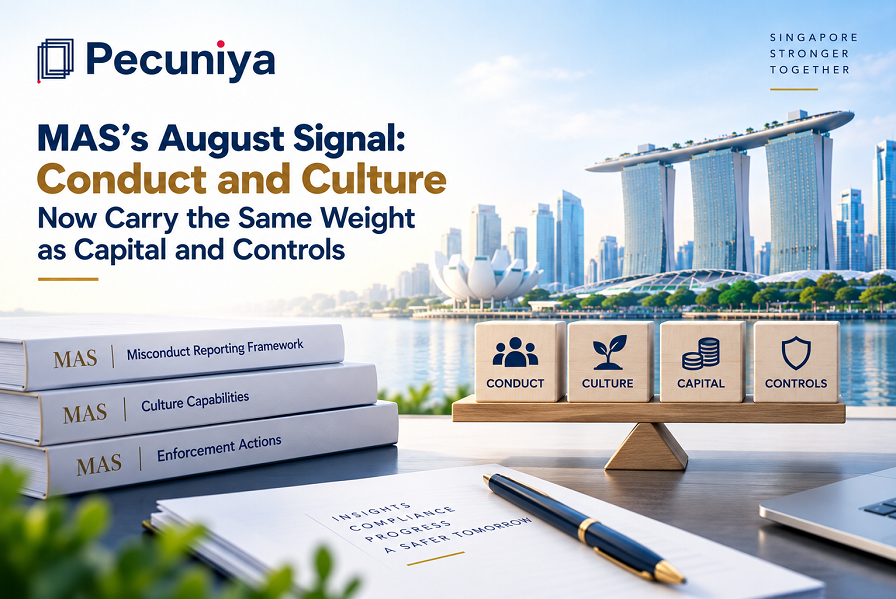
MAS’s August Signal: Conduct and Culture Now Carry the Same Weight as Capital and Controls
A misconduct reporting framework that holds supervisors accountable. A culture capabilities paper that goes beyond policy fixes. And two Prohibition Orders linked to shared passwords. We decode Singapore’s August 2026 MAS update.
Pecuniya Compliance Solutions · 16 September 2026 · 7 min read
The MAS Singapore regulatory update August 2026 brings conduct, culture and accountability firmly into focus. Rather than viewing these developments separately, financial institutions should consider the common message behind them.
First, MAS issued FAQs relating to the misconduct reporting framework that takes effect on 1 January 2027. Second, an Information Paper focuses on culture capabilities and sustainable remediation. Finally, two Prohibition Orders highlight the consequences of weak access discipline.
Each development creates a different compliance task. However, together they point towards a broader regulatory theme.
Financial institutions need to manage conduct and culture with discipline and clear accountability. Moreover, firms need evidence that their controls and remediation work in practice.
This MAS Singapore regulatory update August 2026 explains the key developments and their practical implications. It also highlights steps firms can consider before the end of 2026.
MAS Singapore Regulatory Update August 2026: Misconduct Reporting
24 August 2026 — MAS FAQs on the Misconduct Reporting Framework
MAS released FAQs to help financial institutions prepare for the new misconduct reporting framework. The framework takes effect on 1 January 2027.
Importantly, the guidance takes a practical approach. It addresses how firms should assess, investigate, report and update misconduct cases.
What the FAQs clarify
- The FAQs explain which categories of conduct firms must report. They also address differences across FI types.
- In addition, the guidance addresses gross negligence and material client impact for advisers and insurance intermediaries.
- Supervisors may themselves commit misconduct where their oversight is inadequate. Therefore, accountability can extend upward.
- MAS expects FIs to conduct ongoing fit and proper assessments of representatives and broking staff. Firms should not treat these as one-off exercises.
- Firms should report substantiated findings and provide updates as cases develop.
- However, if later evidence shows that a finding was unsubstantiated, firms should correct or withdraw the report.
- Firms need not disclose a withdrawn and unsubstantiated misconduct report during reference checks. Consequently, an unproven allegation need not follow an individual through that process.
What this means for your firm
With less than four months until implementation, firms should treat the FAQs as a readiness checklist, not background reading.
Start by reviewing your investigation and reporting processes. In addition, brief supervisors and MICs on the accountability provisions and their responsibilities.
For the underlying regulatory requirements, refer directly to the Monetary Authority of Singapore and the relevant MAS misconduct reporting materials.
For further details, please refer to the FAQs on the MAS website here.
MAS Culture Capabilities and Sustainable Remediation
12 August 2026 — MAS Information Paper on Culture Capabilities for Effective Remediation and Sustainable Change
Another important development in the MAS Singapore regulatory update August 2026 concerns culture and remediation.
MAS published an Information Paper on building lasting remediation after serious risk events. The paper identifies four culture capabilities associated with more effective remediation and a lower likelihood of recurrence.
The central message is clear: control fixes alone may not prevent recurrence.
Therefore, firms should examine the behavioral and cultural drivers behind serious risk events. Simply repairing the failed process may not address the underlying cause.
Four capabilities for effective remediation
1. Strong board and senior management leadership
Boards and senior management should actively lead culture. Responsibility should not sit solely with control functions.
2. Robust culture root cause analysis
Investigations should examine behavioral and organizational drivers. In particular, firms should connect those drivers to the resulting behaviors and outcomes.
3. Targeted and mutually reinforcing interventions
Remediation should go beyond policy changes and training. For example, firms may also need to consider leadership behavior, incentives and communication.
4. Culture monitoring and independent validation
Finally, firms should monitor behavioral indicators over time. These may include psychological safety, escalation quality and repeat audit findings.
What this means for your firm
If your firm conducts a root cause analysis, avoid generic conclusions such as “poor culture.”
Instead, identify specific behaviours and connect them to their underlying drivers. Then consider how those factors contributed to the risk outcome.
In addition, build culture indicators into your remediation monitoring. Completion of an action plan should not automatically mark the end of remediation.
The Information Paper was published on 12 August 2026 and sets out MAS’s supervisory observations on these four capabilities.
For further details, please refer to the Information Paper on the MAS website here.
Two Prohibition Orders Reinforce the Same Lesson
August’s enforcement actions also highlight the importance of access discipline.
Both cases involved individuals who misused access and trust. Consequently, they provide a practical reminder that access controls can have implications beyond technology risk.
Enforcement Snapshot — Ms Lai Mei Lin
Outcome: Six-Year Prohibition Order
Breach: Unauthorised system access, forgery and misconduct for personal gain
Fine: None
Regulator: MAS
Ms Lai was a former representative and Unit Manager at Manulife Financial Advisers.
She obtained login credentials from two representatives under her supervision. She then used those credentials to access accounts within the firm’s systems.
In addition, she forged client and representative signatures when submitting insurance policies. In her supervisory capacity, she approved those policies herself. She also forged policy surrender forms.
MAS subsequently assessed her as no longer fit and proper following her criminal conviction. It then imposed a six-year Prohibition Order.
For the regulatory source, see the MAS Prohibition Order against Lai Mei Lin.
Enforcement Snapshot — Ms Low Jia Mei, Camie
Outcome: Four-Year Prohibition Order
Breach: Unauthorised access to customer information
Fine: S$12,000 court fine
Regulator: MAS
Ms Low was a former relationship manager at Standard Chartered Bank (Singapore).
On multiple occasions, she used other employees’ login credentials to access customer information. The information included personal and transactional data. However, the access was unrelated to her role.
A court subsequently convicted her under the Computer Misuse Act and imposed a S$12,000 fine.
Following the conviction, MAS assessed her as no longer fit and proper. It imposed a four-year Prohibition Order restricting her from regulated activities and management roles.
For further details, see the MAS Prohibition Order against Low Jia Mei, Camie.
What this means for your firm
Both cases highlight risks associated with credential sharing and unauthorized access.
Therefore, firms should give access controls and periodic access reviews appropriate attention. External cyber threats remain important. However, internal access discipline matters too.
Supervisory responsibilities also deserve attention. In particular, firms should consider whether access privileges align with roles and responsibilities.
Moreover, financial penalties are not the only potential consequence of misconduct. Prohibition Orders can create significant and long-lasting professional consequences.
Frequently Asked Questions
When does MAS’s new misconduct reporting framework take effect?
The framework takes effect on 1 January 2027.
MAS released FAQs in August 2026 to help financial institutions prepare. In particular, they address the assessment, investigation, reporting and updating of misconduct cases.
Can supervisors face misconduct findings under the MAS framework?
The FAQs address circumstances in which supervisory oversight can itself become relevant to misconduct assessment.
Therefore, firms should consider supervisory accountability when reviewing their governance and investigation frameworks.
What did MAS’s August 2026 Prohibition Orders involve?
One case involved a former Manulife Financial Advisers Unit Manager and unauthorized system access and forgery.
The other involved a former Standard Chartered Bank relationship manager. In that case, the individual accessed customer information using other employees’ credentials.
Both cases ultimately resulted in multi-year Prohibition Orders.
What does MAS expect from culture remediation after a risk event?
MAS’s Information Paper identifies four connected capabilities. These cover leadership, root cause analysis, targeted interventions, and monitoring and validation.
As a result, firms should look beyond immediate control fixes when assessing serious or recurring risk events.
Looking Ahead: What the MAS Singapore Regulatory Update August 2026 Means
Taken together, August’s developments point towards a connected approach to compliance.
Conduct, culture, accountability and access discipline should not operate in separate silos. Instead, firms should consider how these areas interact across governance, investigations and remediation.
Clear accountability remains important. Likewise, firms need credible investigations and evidence that corrective actions produce sustainable change.
For example, misconduct readiness can inform culture monitoring. Access-control weaknesses can also reveal broader behavioral or supervisory concerns.
A connected approach may therefore help management identify weaknesses earlier. It can also support a more consistent response when incidents occur.
For another example of how regulatory expectations increasingly translate into practical risk frameworks, read Pecuniya’s AI Risk Assessment: A Step-by-Step Guide to Responsible AI for Singapore Financial Institutions.
How Pecuniya Can Help
Singapore’s regulatory landscape continues to evolve. Therefore, awareness alone may not be enough.
At Pecuniya Compliance Solutions Pte. Ltd., we help financial institutions translate regulatory requirements into practical compliance measures.
Our support includes compliance audits, licensing, AML/CFT framework design and access-control reviews.
You can also explore Pecuniya’s wider compliance insights and regulatory updates for practical guidance on developments affecting Singapore financial institutions.
Ready to see where your compliance framework stands? Get in touch with Pecuniya for a tailored review, or explore our full August 2026 Singapore Regulatory Update for the complete breakdown.
Disclaimer: Pecuniya Compliance Solutions Pte. Ltd. provides this article for general informational purposes only. It summarizes regulatory developments and does not constitute legal or regulatory advice. Readers should refer to the relevant regulators’ original publications before relying on this information.
Leave a Reply