

BCM Readiness Checklist for MAS-Regulated Financial Institutions
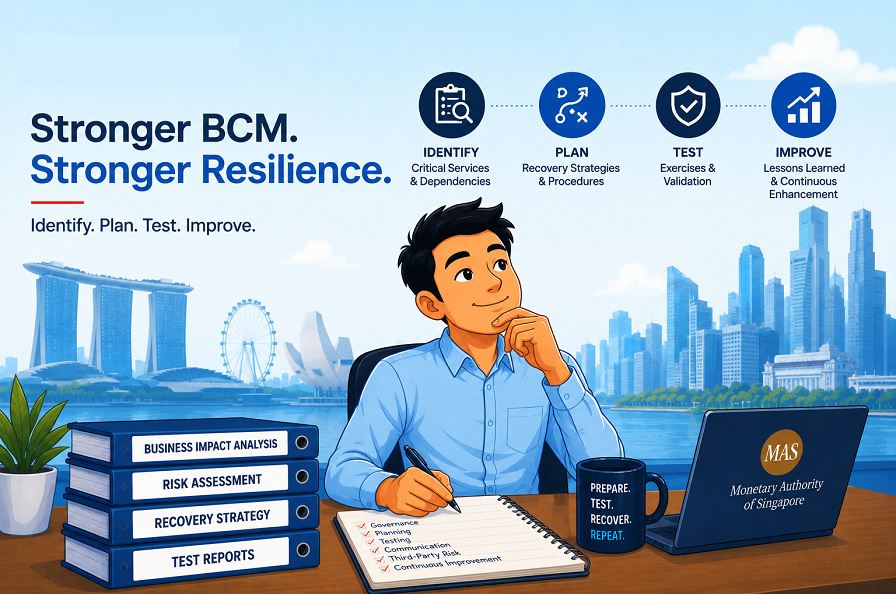
BCM Readiness Checklist helps MAS-regulated financial institutions assess whether their Business Continuity Management program is prepared for independent audits and real-world disruptions.
This practical BCM Readiness Checklist highlights the essential governance, testing, recovery planning, and operational resilience controls every organization should review before its next MAS BCM audit.
Before using this BCM Readiness Checklist, we recommend reading our MAS BCM Audit Readiness guide to understand the regulatory expectations and independent audit requirements for MAS-regulated financial institutions.
In previous post BCM Audit Findings, we examined the recurring findings, risk implications, and real-world scenarios that surface during a MAS Business Continuity Management Audit. This concluding installment turns those insights into action: a practical implementation roadmap, a readiness checklist, the mistakes to avoid, and answers to the questions financial institutions ask most.
BCM Implementation Roadmap
Business Continuity Management (BCM) should never be treated as a one-time implementation project. It is an ongoing governance and operational resilience program that evolves alongside business growth, technological change, and emerging risk.
For MAS-regulated financial institutions, passing a MAS Business Continuity Management Audit is not the end goal — it is a checkpoint. The real objective is ensuring critical business services remain available during severe but plausible disruptions.
The roadmap below sets out a structured, six-step approach to building and maintaining a mature BCM framework that satisfies both regulatory expectations and day-to-day operational reality.
What Should a BCM Implementation Roadmap Include?
A BCM implementation roadmap should progress through six stages: establishing governance and executive sponsorship, identifying critical business services through a Business Impact Analysis, defining recovery strategies and objectives, developing practical continuity plans, conducting regular testing and exercising, and continuously monitoring and improving the programme.
Step 1 — Establish Strong Governance
A successful BCM program starts with clear ownership and executive sponsorship.
Key actions include:
- Obtain Board and Senior Management approval for the BCM framework.
- Define governance committees and reporting structures.
- Assign BCM responsibilities across business units, technology, risk, compliance, and operations.
- Establish regular management reporting on BCM maturity and resilience metrics.
- Integrate BCM into the Enterprise Risk Management (ERM)
Step 2 — Identify Critical Business Services
Rather than focusing solely on departments or applications, identify the services that are essential to customers and regulatory obligations.
Activities include:
- Conduct a Business Impact Analysis (BIA).
- Identify critical business services.
- Determine supporting systems and applications.
- Identify key personnel and specialised skills.
- Map internal and external dependencies.
- Document customer impact and regulatory impact.
Step 3 — Define Recovery Strategies
Recovery strategies should enable critical services to resume within agreed recovery objectives.
Typical considerations include:
- Alternate work locations
- Cloud recovery capabilities
- Data backup strategies
- Manual processing procedures
- Workforce resilience
- Vendor failover arrangements
- Crisis communication channels
Recovery strategies should be practical, cost-effective, and tested.
Step 4 — Develop Practical Business Continuity Plans
Effective Business Continuity Plans should be easy to understand and actionable during stressful situations.
Plans should include:
- Incident activation criteria
- Escalation procedures
- Crisis management responsibilities
- Communication protocols
- Recovery procedures
- Vendor contact details
- Recovery checklists
Avoid creating lengthy documents that become difficult to use during an emergency.
Step 5 — Conduct Regular Testing and Exercising
Testing validates whether recovery strategies work in practice.
A mature BCM testing programme should include:
- Tabletop exercises
- Disaster Recovery (DR) testing (see: Disaster Recovery vs. Business Continuity)
- Cyber incident simulations
- Crisis communication exercises
- Work Area Recovery testing
- Third-party participation
- Executive decision-making exercises
Every exercise should conclude with lessons learned and measurable improvement actions.
Step 6 — Monitor, Review and Improve
Business Continuity Management should continuously evolve.
Review the program following:
- Significant organizational changes
- Technology implementation
- Vendor on-boarding
- Regulatory updates
- Major incidents
- Internal audits (see: Internal Audit Services)
- External audits
- Testing outcomes
Continuous improvement ensures BCM remains aligned with business priorities and regulatory expectations.
How to use BCM Readiness Checklist
Use the checklist below to benchmark your organization’s current level of MAS Business Continuity Management audit readiness across governance, testing, and third-party risk.
BCM Readiness Checklist: Governance and Oversight
☐ BCM Policy approved by Senior Management
☐ Defined governance structure
☐ Assigned BCM ownership
☐ Board reporting established
☐ Regular BCM reviews conducted
BCM Readiness Checklist for Business Impact Analysis
☐ Critical business services identified
☐ Business Impact Analysis updated
☐ The Recovery priorities validated
☐ Supporting applications identified
☐ Key personnel documented
BCM Readiness Checklist for Recovery Testing
☐ Recovery Time Objectives defined
☐ The Recovery Point Objectives documented
☐ Alternative operating arrangements established
☐ Manual workarounds documented
☐ Data recovery strategy validated
Business Continuity Plans
☐ Plans reviewed within the last 12 months
☐ Contact lists updated
☐ Escalation procedures validated
☐ Crisis communication templates prepared
☐ Recovery procedures tested
Testing
☐ Annual testing completed
☐ Disaster Recovery exercises performed
☐ Executive participation included
☐ Third-party providers involved
☐ Lessons learned documented
Third-Party Risk
Since many critical services depend on external providers, see our Third-Party Risk Management guide for a deeper dive into dependency mapping.
☐ Critical vendors identified
☐ Dependency mapping completed
☐ Vendor recovery capabilities assessed
☐ Exit strategies documented
☐ Outsourcing risks periodically reviewed
Continuous Improvement
☐ Audit findings remediated
☐ Action items tracked
☐ BCM metrics reported
☐ Program reviewed annually
☐ Continuous improvement process established
Common Business Continuity Management Mistakes
Even organizations with mature governance frameworks can encounter recurring weaknesses that reduce the effectiveness of their BCM program.
Mistake 1 — Treating BCM as an Annual Compliance Exercise
Updating documentation only before an audit creates the illusion of preparedness without building genuine operational resilience.
Recommended Approach: Embed BCM activities throughout the year.
Mistake 2 — Focusing Only on Documentation
A well-written Business Continuity Plan is valuable only if it reflects operational reality and can be executed during an incident.
Recommended Approach: Prioritize practical capability over documentation volume.
Mistake 3 — Ignoring Third-Party Dependencies
Many critical services depend on vendors, cloud providers, telecommunications providers, and outsourced partners.
Recommended Approach: Maintain comprehensive dependency mapping and regularly assess third-party resilience.
Mistake 4 — Performing Repetitive Testing
Running the same tabletop exercise every year provides limited assurance.
Recommended Approach: Increase complexity and realism over time by introducing cross-functional scenarios.
Mistake 5 — Limited Executive Engagement
Business Continuity Management should not be viewed solely as an IT responsibility.
Recommended Approach: Ensure active Board and Senior Management participation in governance, exercises, and programme oversight.
Frequently Asked Questions
What is Business Continuity Management?
Business Continuity Management (BCM) is a governance and operational resilience framework that enables MAS-regulated financial institutions to continue delivering critical business services during disruptions. The MAS Guidelines on Business Continuity Management (June 2022) expect firms to establish recovery strategies, conduct Business Impact Analyses, perform regular testing, and continuously improve resilience capabilities.
Is Business Continuity Management mandatory for MAS-regulated financial institutions?
Yes. MAS expects financial institutions to establish and maintain an effective Business Continuity Management framework aligned with its supervisory expectations.
What are Recovery Time Objectives (RTOs)?
RTOs define the maximum acceptable time within which a business service or system should be restored after a disruption.
Should third-party vendors participate in BCM exercises?
Where appropriate, yes. Critical service providers play an essential role in delivering business services and should be included in resilience planning and testing.
How frequently should Business Continuity Plans be reviewed?
Plans should be reviewed at least annually and following significant business, technology, or regulatory changes.
What evidence do auditors typically request?
Auditors commonly review:
- BCM Policy
- Business Impact Analysis
- Recovery Strategies
- Business Continuity Plans
- Testing Reports
- Lessons Learned
- Management Reporting
- Vendor Assessments
- Training Records
- Governance Documentation
What is the biggest misconception about BCM?
That it exists primarily to satisfy auditors. In reality, BCM exists to ensure the organization can continue delivering critical business services when disruptions occur.
How can Internal Audit strengthen BCM?
Internal Audit provides independent assurance by assessing the effectiveness of governance, controls, testing, documentation, recovery strategies, and remediation activities, helping organizations continuously improve their BCM maturity. Learn more about our Internal Audit Services.
Conclusion
Using a BCM Readiness Checklist regularly helps financial institutions identify gaps before they become audit findings or operational disruptions. Rather than treating BCM as an annual compliance exercise, organisations should embed this BCM Readiness Checklist into their ongoing governance, testing, and continuous improvement activities to strengthen operational resilience and prepare confidently for future MAS BCM audits.
Business Continuity Management has evolved far beyond a regulatory obligation. For Singapore’s financial sector, it is a strategic capability that protects customers, maintains market confidence, and enables organizations to continue delivering critical services during periods of disruption — and it is precisely this capability that a MAS Business Continuity Management Audit is designed to test.
The MAS Guidelines on Business Continuity Management reinforce an important message: resilience is not demonstrated by the size of a policy manual or the volume of audit evidence. It is demonstrated by an organization’s ability to respond, recover, and continue operating when faced with severe but plausible disruptions.
Financial institutions should also align their BCM program with the MAS Technology Risk Management (TRM) Guidelines, which provide guidance on technology governance, cyber resilience, and IT risk management.
Institutions that embed BCM into governance, operational processes, technology planning, third-party risk management, and organizational culture are better positioned to meet regulatory expectations while strengthening long-term business resilience.
Rather than asking, “Are we ready for the next audit?”, organizations should ask:
“If a major disruption occurred today, could we continue delivering our most critical business services?”
The answer to that question defines true operational resilience.
About Pecuniya
At Pecuniya, we partner with MAS-regulated financial institutions to strengthen Business Continuity Management, Operational Resilience, Internal Audit, Risk Management, and Regulatory Compliance.
Our approach goes beyond audit preparation. We help organizations design practical, sustainable, and risk-based BCM programs that align with MAS expectations while supporting long-term operational resilience.
Whether conducting independent BCM Gap Assessments, performing internal audits, identifying control gaps, or supporting remediation initiatives, our focus is on helping clients build resilience that works in practice — not just on paper.
Business Continuity isn’t a show for audit day. It’s a habit for every day.
Leave a Reply