

BCM Audit Findings: 7 Common Issues MAS Firms Should Fix
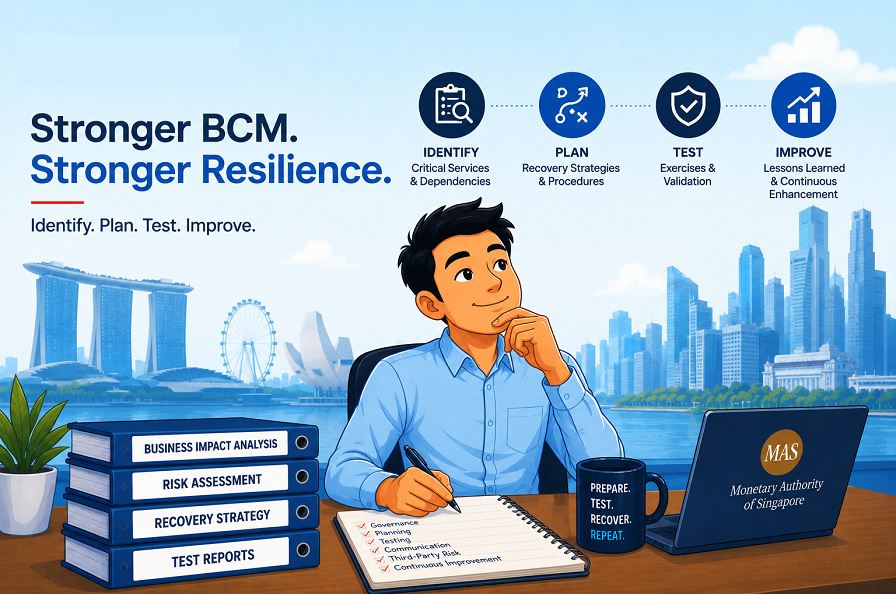
BCM Audit Findings consistently reveal the same operational resilience gaps across many MAS-regulated financial institutions. Despite significant investment in Business Continuity Management (BCM), organisations often struggle to translate documented plans into practical recovery capabilities.
Understanding these BCM Audit Findings enables firms to strengthen resilience, improve governance, and prepare more effectively for future MAS supervisory reviews and independent BCM audits.
Why Many BCM Programs Struggle Despite Significant Investment
Most financial institutions have invested considerable time and resources into Business Continuity Management (BCM). They maintain documented Business Continuity Plans (BCPs), perform periodic exercises, and appoint dedicated coordinators to oversee the program. Yet a BCM Audit Findings routinely surfaces the same weaknesses, even in institutions that consider their programs mature.
The issue is rarely the absence of documentation — it is the gap between documented plans and operational reality.
As financial institutions become increasingly dependent on cloud technologies, outsourced service providers, digital platforms, and interconnected business ecosystems, BCM must evolve from a documentation-focused exercise into a continuously managed resilience capability.
The institutions that consistently perform well during MAS supervisory reviews are those that integrate Business Continuity Management into daily operations rather than treating it as an annual compliance obligation.
What Does a MAS BCM Audit Assess?
A MAS Business Continuity Management Audit assesses whether a financial institution can continue delivering critical business services during severe but plausible disruptions. Auditors examine the currency of the Business Impact Analysis, the validation of Recovery Time Objectives, the operational usability of continuity plans, the realism of BCM testing, third-party dependency mapping, crisis communication readiness, and governance and ownership across the organization.
For the complete regulatory expectations, refer to the Monetary Authority of Singapore (MAS) Business Continuity Management Guidelines (June 2022), which provide detailed guidance on governance, critical business services, dependency mapping, testing, crisis management, and independent BCM audits.
Read Article: MAS BCM Audit Readiness: Building Operational Resilience Beyond Audit Day
Common BCM Audit Findings
Across the financial services industry, several recurring themes emerge during BCM audit reviews and internal audits. These observations often indicate opportunities to strengthen governance, improve operational resilience, and better align with MAS expectations.
1. Business Impact Analysis (BIA) Is Outdated
A Business Impact Analysis forms the foundation of every BCM program. However, auditors frequently observe that BIAs have not kept pace with organizational change.
Common issues include:
- Newly launched products not included
- Organizational restructuring not reflected
- Critical systems omitted
- Business dependencies incorrectly mapped
- Recovery priorities no longer accurate
- Inconsistent impact assessments across departments
An outdated BIA affects every downstream component of the BCM program, including recovery strategies, recovery objectives, testing, and resource allocation. For a deeper walkthrough, see our Business Impact Analysis Guide.
Best Practice: Conduct a comprehensive BIA review whenever significant organisational, technological, or operational changes occur, rather than relying solely on annual updates.
2. Recovery Time Objectives (RTO) Lack Business Validation
Many organizations define Recovery Time Objectives during implementation and rarely revisit them.
During audits, institutions often struggle to explain:
- Why a specific RTO was selected
- Whether it remains appropriate
- Whether business owners approved it
- Whether recovery capabilities actually support it
A Recovery Time Objective should reflect business requirements — not assumptions made years earlier. Our Recovery Time Objectives Explained article covers how to set and validate RTOs against current risk appetite.
Best Practice: Review recovery objectives jointly with business units, technology teams, operational risk, and senior management to ensure alignment with current business expectations.
3. Business Continuity Plans Are Documentation-Heavy but Operationally Weak
Some organizations maintain extensive continuity documentation running hundreds of pages. Ironically, lengthy documents often become difficult to use during an actual crisis.
Auditors frequently observe:
- Unclear recovery procedures
- Conflicting instructions
- Duplicate content
- Missing escalation paths
- Obsolete organizational structures
- Inconsistent terminology
During an operational disruption, simplicity often proves more valuable than volume.
Best Practice: Develop concise, role-based recovery procedures supported by detailed appendices where necessary. Plans should enable rapid decision-making under pressure.
4. BCM Testing Is Conducted Only to Meet Annual Requirements
BCM testing remains one of the strongest indicators of BCM maturity. Unfortunately, some organizations approach testing as a compliance exercise.
Typical observations include:
- Annual tabletop exercises with limited realism
- Repetitive scenarios each year
- Minimal executive participation
- Technology recovery not fully validated
- Third-party providers excluded
- Lessons learned not implemented
A successful exercise is not measured by whether everything went according to plan. Its true value lies in identifying weaknesses before a real disruption occurs. See BCM Testing Best Practices for scenario design guidance.
Best Practice: Design increasingly realistic scenarios that challenge people, processes, technology, facilities, and external dependencies. Every exercise should result in measurable improvements.
5. Third-Party Dependency Mapping Is Incomplete
Modern financial institutions depend heavily on external service providers. Critical operations may rely upon:
- Cloud platforms
- Payment gateways
- Telecommunications providers
- Data centres
- Software vendors
- Market data providers
- Outsourcing partners
Despite this reliance, many organizations lack complete visibility into these dependencies.
Auditors often identify:
- Missing vendor inventories
- Undefined recovery expectations
- No documented contingency plans
- Weak oversight of critical suppliers
- Limited understanding of concentration risk
Strong Third Party Risk oversight is now a distinct MAS expectation in its own right — see our Third-Party Risk Management resource for a practical dependency-mapping template.
Best Practice: Maintain a comprehensive dependency map linking every critical business service to its supporting third parties, technology, facilities, personnel, and infrastructure.
6. Crisis Communication Plans Are Not Practical
Communication failures frequently amplify operational disruptions. Many crisis communication plans contain:
- Outdated contact details
- Undefined approval authorities
- Generic messaging templates
- Missing communication channels
- No procedures for communicating with regulators, customers, vendors, or media
During a crisis, delays in communication can rapidly erode stakeholder confidence. Our Crisis Management Framework outlines escalation and messaging protocols institutions can adapt quickly.
Best Practice: Validate communication procedures through regular exercises and maintain multiple communication channels should primary systems become unavailable.
7. Governance and Ownership Are Unclear
Business Continuity Management is sometimes perceived as the responsibility of a single department. Effective BCM requires organization-wide ownership.
Auditors commonly observe uncertainty regarding:
- Who owns the BIA
- Who approves recovery priorities
- Who maintains continuity plans
- Who validates testing outcomes
- Who reports to senior management
- Who tracks remediation activities
Without clear accountability, programs gradually lose effectiveness.
Best Practice: Establish defined governance structures supported by documented roles, responsibilities, reporting lines, and oversight mechanisms.
Quick Answer: What are common BCM audit findings? The most common findings are outdated Business Impact Analyses, unvalidated Recovery Time Objectives, documentation-heavy but operationally weak plans, compliance-driven testing, incomplete third-party dependency mapping, impractical crisis communication plans, and unclear governance and ownership.
Risk Implications of BCM Audit Findings
Business Continuity weaknesses extend far beyond regulatory compliance. They can create significant operational, financial, reputational, and strategic risks.
Operational Risk
Disruptions may prevent critical business services from operating within acceptable recovery time frames. Potential consequences include:
- Payment processing failures
- Trading interruptions
- Customer service outages
- Operational backlogs
- Extended system downtime
Regulatory Risk
Failure to demonstrate effective BCM may attract increased supervisory attention. Possible implications include:
- Regulatory findings
- Enhanced supervisory engagement
- Increased remediation expectations
- Internal audit observations
- Board reporting requirements
Financial Risk
Operational disruptions often generate significant financial costs through:
- Lost revenue
- Incident response expenditure
- Recovery costs
- Contractual penalties
- Customer compensation
- Productivity losses
Reputational Risk
Customers expect financial services to remain available regardless of external events. Extended service interruptions may reduce customer confidence and damage long-term reputation.
Strategic Risk
Weak resilience limits an organization’s ability to respond effectively to emerging threats while pursuing digital transformation initiatives. Operational resilience has become a competitive advantage — not merely a compliance requirement.
Building a Mature BCM Program
Organizations demonstrating higher BCM maturity typically exhibit several common characteristics.
Executive Sponsorship
Leadership actively supports BCM initiatives. Board members receive meaningful reporting rather than compliance-focused metrics.
Integrated Risk Management
BCM aligns closely with:
- Enterprise Risk Management
- Technology Risk
- Cybersecurity
- Third-Party Risk
- Operational Risk
- Crisis Management
- Internal Audit
Continuous Testing
Testing becomes an ongoing improvement mechanism rather than an annual event. Exercises increase in complexity over time and involve multiple business functions.
Data-Driven Decision Making
Leading organizations establish resilience metrics such as:
- Recovery performance
- Test success rates
- Plan review completion
- Dependency coverage
- Issue remediation timelines
These metrics provide management with meaningful insights into program effectiveness.
Culture of Preparedness
Perhaps the greatest differentiator is organizational culture. Employees understand that resilience is everyone’s responsibility. Business continuity considerations become embedded into:
- Project planning
- Change management
- Vendor on-boarding
- Technology implementation
- Risk assessments
- Business decision-making
Real-World Example 1 — Cyberattack on Critical Systems
A ransomware attack encrypts several production servers supporting customer transactions. Because recovery strategies have been regularly tested:
- Recovery teams activate immediately.
- Crisis management procedures are followed.
- Customer communication is coordinated.
- Backup restoration begins within defined recovery objectives.
- Executive management receives regular updates.
- Regulators receive timely notifications where required.
The disruption is managed effectively because recovery capabilities were validated before the incident occurred.
Real-World Example 2 — Cloud Service Provider Outage
A major cloud provider experiences a regional outage affecting multiple financial institutions. An organisation with mature BCM capabilities has already:
- Identified cloud dependencies.
- Assessed concentration risk.
- Established alternate recovery arrangements.
- Tested failover procedures.
- Defined customer communication protocols.
- Prepared executive decision frameworks.
Recovery proceeds according to established plans rather than improvised decisions.
Real-World Example 3 — Loss of Critical Third-Party Vendor
A key outsourcing partner experiences operational failure. Rather than reacting under pressure, the institution already maintains:
- Alternative suppliers
- Contractual recovery obligations
- Escalation procedures
- Manual processing options
- Business service prioritization
Customer impact is significantly reduced because dependency planning was incorporated into the BCM program.
Frequently Asked Questions
How often should a BIA be updated?
A Business Impact Analysis should be reviewed whenever significant organizational, technological, or operational change occurs, in addition to a scheduled annual review, so recovery priorities remain accurate.
How does BCM support Operational Resilience?
BCM provides the recovery strategies, tested procedures, and governance structures that Operational Resilience frameworks rely on to keep critical business services running during severe but plausible disruptions.
Key Takeaways
Business Continuity Management is no longer about maintaining documentation for regulatory inspections. It is about ensuring that financial institutions can continue delivering critical services under severe but plausible disruption scenarios.
The strongest BCM programs share several characteristics:
- They are continuously reviewed.
- They are regularly tested.
- They evolve alongside business change.
- They incorporate third-party resilience.
- They are supported by senior leadership.
- They focus on operational capability rather than documentation.
For MAS-regulated institutions, passing a MAS Business Continuity Management Audit is not the end goal — it is a by-product of these qualities, which also strengthen customer confidence, organizational resilience, and long-term operational sustainability.
As financial institutions become increasingly dependent on digital platforms, cloud services, and interconnected technologies, organisations should also align their BCM programme with the MAS Technology Risk Management (TRM) Guidelines, which provide guidance on technology governance, cyber resilience, IT controls, and operational resilience for MAS-regulated financial institutions. For more information, refer to the MAS Technology Risk Management Guidelines: https://www.mas.gov.sg/regulation/guidelines/technology-risk-management-guidelines
In next post, we will explore a practical implementation roadmap, a BCM readiness checklist, common implementation mistakes, answers to frequently asked questions, and conclude with actionable recommendations for building an audit-ready and resilient BCM program.
Leave a Reply