
MAS TRM Implementation Guide 2026 | Practical Roadmap
MAS TRM Implementation Guide 2026: A Practical Roadmap for FinTechs and Financial Vendors
Introduction
If you sell technology or financial services into Singapore’s banking, insurance, payments, or capital markets sector, Technology Risk Management (TRM) is likely to appear in customer due-diligence requests.
The Monetary Authority of Singapore (MAS) Technology Risk Management Guidelines set expectations for how financial institutions should govern and manage technology and cyber risk. For technology vendors, the practical impact is often indirect but significant: regulated financial institutions may assess a vendor’s security, resilience, access controls, incident response, and third-party risk controls before onboarding or renewing a relationship.
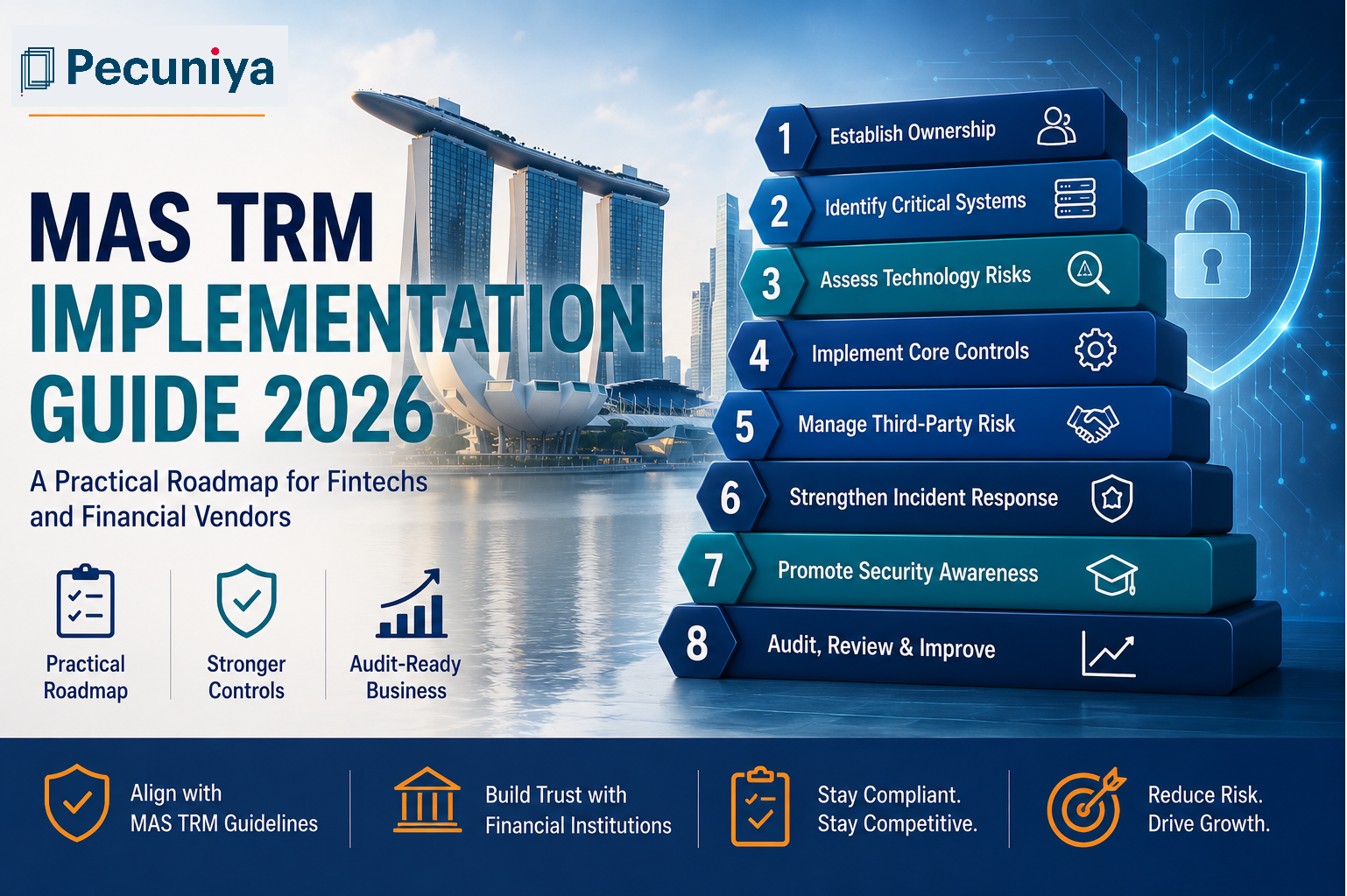
The challenge is turning a principles-based framework into controls that a lean team can actually operate and evidence. This MAS TRM implementation guide provides a practical eight-step roadmap for doing that in 2026.
The recommendations in this article are practical implementation guidance. They should not be treated as a statement that MAS directly regulates every technology vendor in the same way it regulates financial institutions.
Executive Summary
- Start with ownership. Technology risk needs a clearly accountable executive and operational owner.
- Build an accurate inventory of systems, data, services, vendors, and dependencies before selecting controls.
- Assess technology risk using business impact, confidentiality, integrity, and availability.
- Prioritize practical controls across access management, cybersecurity, change management, resilience, monitoring, and operations.
- Treat third-party risk as part of your technology risk environment, not as a procurement-only exercise.
- Prepare for incidents through logging, response playbooks, escalation paths, and realistic exercises.
- Maintain evidence continuously so audits and financial-institution due-diligence requests do not become last-minute projects.
- Review the framework regularly. TRM alignment is an ongoing management discipline, not a one-time certification exercise.
What Is MAS TRM and Why Does It Matter?
MAS TRM refers to the Technology Risk Management Guidelines issued by the Monetary Authority of Singapore. The guidelines provide principles and expectations covering governance, technology risk assessment, cybersecurity, access management, system development, operational resilience, incident management, and third-party technology risk.
For regulated financial institutions, TRM is part of the broader technology and operational risk environment. For FinTechs, SaaS companies, cloud providers, payments technology firms, and other vendors serving those institutions, the commercial impact can be substantial even when the vendor is not itself directly subject to every MAS expectation.
A financial institution may ask a technology provider to demonstrate security controls, business continuity arrangements, access governance, vulnerability management, incident response, and evidence of independent testing. TRM alignment can therefore become a customer requirement as much as a compliance consideration.
Expert analysis: vendors that organize their evidence before enterprise sales processes begin can reduce repeated questionnaires, shorten security reviews, and give customers greater confidence in the control environment.
The 8-Step MAS TRM Implementation Roadmap
Step 1: Establish Clear Ownership
A technology risk program needs an accountable owner before it needs more policies.
- Name an executive sponsor, such as the CTO, CIO, or CEO, depending on the organization’s structure.
- Assign an operational owner who coordinates engineering, IT, security, compliance, and vendor activities.
- Document responsibility for access, incidents, change management, backup, vendors, and resilience.
- Set a regular management reporting cadence appropriate to the organization’s risk profile.
Step 2: Build an Accurate System and Asset Inventory
You cannot manage technology risk effectively if you do not know what you operate.
- Inventory applications, cloud services, infrastructure, data stores, integrations, endpoints, and critical suppliers.
- Identify systems that could materially affect customers, revenue, sensitive information, regulatory obligations, or core operations if they became unavailable or compromised.
- Record owners, business purpose, data handled, hosting location, dependencies, recovery arrangements, and key suppliers.
Step 3: Conduct a Technology Risk Assessment
Assess the risks associated with each critical asset or service and connect technical exposure with business consequences.
- Identify threats and vulnerabilities affecting critical systems and data.
- Assess confidentiality, integrity, and availability risks.
- Document existing controls and test whether they operate effectively.
- Rank gaps by business impact, likelihood, regulatory importance, and remediation effort.
- Create a risk register with named owners and target dates.
Step 4: Implement Controls Across Core Risk Areas
A large regulatory framework becomes easier to manage when controls are grouped into practical operating areas. The exact control set should reflect the organization’s size, services, architecture, and risk profile.
| Risk Area | Practical Controls | Evidence Examples |
| Access Management | Least privilege, strong authentication, privileged-access review | Access reviews, MFA records, privileged-account logs |
| Cybersecurity | Endpoint protection, network controls, vulnerability management | Security reports, scan results, remediation records |
| Change Management | Approval, testing, version control, segregation of duties | Change tickets, approvals, deployment records |
| Resilience | Backups, recovery plans, redundancy, recovery testing | Backup reports, DR tests, recovery results |
| Monitoring | Logging, alerting, incident detection, escalation | SIEM/log reports, alerts, incident records |
| IT Operations | Patch, configuration and capacity management | Patch dashboards, configuration and capacity reports |
Prioritize controls that address material risks first. For many lean organizations, privileged-access controls, encryption, secure development practices, tested backups, vulnerability management, and incident response provide a strong starting point.
Step 5: Strengthen Third-Party Technology Risk Management
A critical supplier can become a critical point of failure. Third-party risk should therefore form part of the technology risk programme rather than sit entirely within procurement.
- Maintain a vendor inventory and classify suppliers according to access, criticality, data exposure, and operational dependency.
- Perform proportionate due diligence before onboarding higher-risk suppliers.
- Include appropriate security, incident notification, audit, data handling, and termination provisions in contracts.
- Review critical suppliers periodically rather than relying only on the original onboarding assessment.
- Track open vendor findings and escalate material issues to management.
Industry best practice: for critical suppliers, combine contractual assurance with independent reports, security assessments, targeted testing, and ongoing monitoring where appropriate.
Step 6: Build Incident Detection and Response
Good preventive controls reduce risk, but they cannot eliminate incidents. A mature TRM programme assumes incidents can occur and prepares the organization to detect, contain, recover, and learn from them.
- Define incident severity levels and escalation criteria.
- Maintain playbooks for ransomware, data compromise, major service outages, and privileged-account compromise.
- Centralize or appropriately correlate security and operational logs.
- Test response procedures through tabletop exercises or realistic scenarios.
- Conduct post-incident reviews and track remediation to closure.
For vendors supporting regulated financial institutions, contractual incident-notification requirements may be particularly important. Review customer agreements carefully so internal escalation timelines support external notification obligations.
Step 7: Make Security Awareness Part of the Operating Model
Technology controls can fail when employees do not understand their responsibilities. Security awareness should therefore extend beyond engineering and security teams.
- Include security and acceptable-use requirements in employee onboarding.
- Provide periodic awareness training for all functions handling sensitive information.
- Use phishing simulations or tabletop exercises where appropriate.
- Train employees to report suspicious activity and potential security incidents.
- Track completion and follow up on repeated weaknesses.
Step 8: Audit, Review, and Improve
TRM implementation should operate as a continuous improvement cycle. Controls, systems, vendors, threats, and business models change, so the risk assessment and evidence base must change with them.
- Maintain an annual review calendar for the technology risk framework.
- Perform targeted reviews after major system, architecture, vendor, or business changes.
- Track material findings, owners, deadlines, and closure evidence.
- Use independent assurance where the risk or customer requirements justify it.
- Report meaningful technology risk indicators to senior management.
MAS TRM Implementation Checklist
| Area | Key Question | Evidence to Maintain | Priority |
| Governance | Who owns technology risk? | Governance document, roles, management minutes | High |
| Asset Inventory | Do we know our critical systems and dependencies? | Current asset/system register | High |
| Risk Assessment | Have material technology risks been identified? | Risk assessment and risk register | High |
| Access | Are privileged and user accesses controlled? | Access reviews, MFA evidence, logs | High |
| Resilience | Can critical services recover within business requirements? | BCP/DR plans and test results | High |
| Incident Response | Can the organization detect and respond to major incidents? | Playbooks, logs, exercise reports | High |
| Third Parties | Are critical suppliers assessed and monitored? | Vendor register, assessments, contracts | High |
| Change Management | Are material changes controlled and traceable? | Change records and approvals | Medium |
| Training | Do employees understand security responsibilities? | Training records and exercise results | Medium |
| Assurance | Are controls independently reviewed where appropriate? | Audit reports and remediation tracking | Medium |
Documentation to Keep Audit-Ready
There is no single universal document pack that fits every organization. The evidence set should reflect the organization’s services, risks, systems, customers, and contractual obligations.
- Technology risk management framework or policy
- Current system and asset inventory
- Technology risk assessments and risk register
- Access management and privileged-access procedures
- Backup and disaster recovery documentation
- Incident response plan and incident records
- Vulnerability and patch management records
- Change management records
- Third-party risk assessments and key supplier contracts
- Security architecture or data-flow documentation
- Security awareness and training records
- Internal or independent audit reports and management responses
Common MAS TRM Implementation Roadblocks
We do not have a dedicated security team.
A lean team can still establish clear accountability. Assign an operational owner, define responsibilities, and use external specialists where internal capability is limited. The objective is a functioning control environment, not a large compliance department.
We do not know what counts as a critical system.
Start with business impact. Ask which systems would materially disrupt customers, revenue, sensitive information, regulatory obligations, or core operations if they failed.
Vendor risk management is too manual.
Prioritize suppliers according to risk. Automate repeatable activities such as questionnaires, review reminders, evidence collection, and issue tracking where practical.
Audits keep finding the same issues.
Repeated findings usually indicate a remediation problem. Every material finding should have an owner, deadline, root cause, action plan, and closure evidence.
Expert Recommendations for 2026
Expert Analysis: The following recommendations are practical guidance from a compliance and risk-management perspective. They are not presented as additional MAS requirements.
- Build one evidence library instead of creating separate evidence packs for every customer questionnaire.
- Map controls to multiple frameworks where possible so one control can support several assurance requirements.
- Connect technology risk, business continuity, cybersecurity, vendor risk, and incident management rather than operating them as isolated programmes.
- Measure remediation performance, not only the number of controls documented.
- Test recovery and incident response in realistic scenarios instead of relying solely on policy reviews.
- Prepare an executive-level technology risk dashboard covering material risks, overdue actions, critical suppliers, major incidents, and resilience indicators.
Frequently Asked Questions
What is MAS TRM?
MAS Technology Risk Management refers to the MAS Technology Risk Management Guidelines, which set out expectations for managing technology and cyber risks within financial institutions.
Does MAS TRM directly apply to every FinTech vendor?
Not necessarily. Direct applicability depends on the organization’s regulatory status and activities. Vendors serving regulated institutions may still face TRM-related contractual and due-diligence expectations.
What is the best first step for MAS TRM implementation?
Start by assigning ownership and building an accurate inventory of systems, data, services, and critical dependencies.
How often should a technology risk assessment be reviewed?
The review cycle should reflect the organization’s risk profile and change environment. Major changes, incidents, or significant architecture changes should trigger reassessment.
What evidence should a vendor maintain?
Typical evidence includes risk assessments, access reviews, incident records, vulnerability reports, backup tests, change records, vendor assessments, training records, and audit reports.
Is a policy enough for TRM compliance?
No. A policy describes intent. Mature assurance requires evidence that controls operate effectively and that identified issues are remediated.
How should FinTechs manage third-party risk?
Maintain a risk-based vendor inventory, conduct proportionate due diligence, establish contractual protections, monitor critical suppliers, and track material findings.
What are the most important technology controls for a lean team?
Priorities depend on risk, but access control, privileged-account security, vulnerability management, secure development, backup and recovery, monitoring, and incident response are commonly important.
Can MAS TRM help vendors win financial-services customers?
Strong control evidence can support customer due diligence and reduce friction during security and procurement reviews.
How can a company prepare for an audit?
Create a control inventory, map evidence to each control, identify gaps, assign remediation owners, and conduct an independent readiness review before the formal assessment.
Conclusion
MAS TRM implementation does not need to become a massive compliance project. The strongest approach is practical: establish ownership, understand the technology environment, assess risk, implement proportionate controls, manage suppliers, prepare for incidents, train employees, and maintain evidence.
For FinTechs and financial technology vendors, the commercial value is also important. A well-organized technology risk programme can make customer due diligence faster, improve resilience, and give financial-institution customers confidence that security and operational risks are actively managed.
The objective is not to produce more documentation. It is to build a control environment that works, can be demonstrated, and improves as the organization grows.
How Pecuniya Can Help
Pecuniya Compliance Solutions helps FinTechs, technology providers, and regulated businesses turn regulatory expectations into practical, evidence-backed control programmes.
- MAS TRM gap assessments
- Technology risk framework and control mapping
- Third-party and vendor risk assessments
- Audit and due-diligence readiness
- Technology risk and cybersecurity governance
- Evidence and remediation management
- Independent compliance and control reviews
If your organization is preparing for a financial-institution vendor review, strengthening its technology risk framework, or building an audit-ready evidence base, Pecuniya can help structure the program around your actual risk and operating model.
Leave a Reply