

MAS Regulatory Update July 2026: What Singapore Firms Must Know
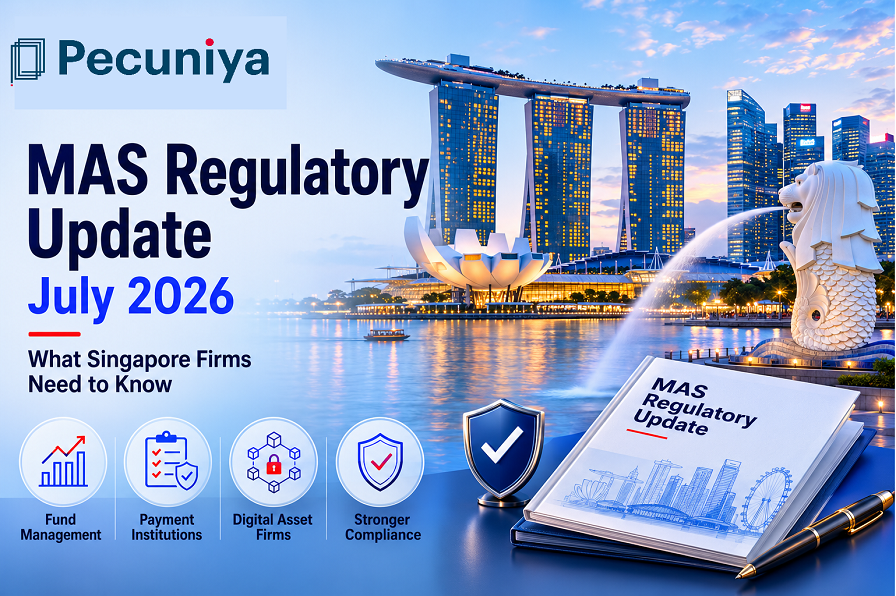
MAS Regulatory Update, July 2026: What Fund Managers, Payment Institutions, and Crypto Firms Need to Know
July 2026 was not a quiet month at the Monetary Authority of Singapore. In the space of two weeks, MAS issued three separate publications that touch three very different corners of the financial industry: fund management, payment services, and digital assets. Taken individually, each one is a meaningful compliance update. Taken together, they tell a bigger story about where Singapore’s regulatory bar is heading in 2026 and beyond.
If your firm holds a Capital Markets Services licence, a Payment Services Act licence, or operates in the digital payment token (DPT) space, this article breaks down exactly what changed, why it matters, and what your compliance team should be doing about it right now.
Want the full picture? Read our July 2026 Singapore Regulatory Update. It covers the latest MAS regulatory developments and their practical implications.
Why July 2026 Matters More Than It Looks
On the surface, these three updates look like routine housekeeping: a revised set of guidelines here, a new audit framework there, an information paper for good measure. But look closer and a pattern emerges. MAS is consistently asking firms to move away from reactive, checklist-style compliance and toward genuinely embedded risk management — frameworks that are designed into the business from day one, not patched on after something goes wrong.
That shift matters because it changes what “being compliant” actually looks like to an examiner. A firm that can produce the right policy document is no longer automatically in the clear. MAS increasingly wants to see documented decision-making, defensible governance, and evidence that risk management is a living process, not a filing cabinet exercise.
With that context in mind, here is what actually changed in July.
1. MAS Revises Liquidity Risk Management Guidelines for Fund Management Companies
Effective 2 July 2026
After a consultation that closed in February 2026, MAS has finalized an updated set of Liquidity Risk Management (LRM) guidelines for fund management companies. The revisions bring Singapore’s expectations in line with international standards set by IOSCO and the Financial Stability Board, and they raise the bar in several concrete ways.
What’s actually changing:
- Anti-dilution tools take priority. Fund managers are now expected to lean on tools like swing pricing and anti-dilution levies before reaching for redemption gates or suspensions.
- Liquidity planning now covers more than redemption. Margin calls, collateral demands, and derivative exposures all need to factor into liquidity risk assessments.
- Liquidity is a design-stage consideration. Funds should be built from the outset with redemption terms, liquidity tools, and underlying asset liquidity working together — not bolted together after launch.
- Stress testing must simulate multiple shocks at once. Market liquidity strain, counterparty default, margin calls, and redemption pressure now need to be modelled together, not in isolation.
- Governance expectations have tightened. Boards and senior management need clear escalation pathways and documented decision-making around liquidity tools.
- Investor disclosures need more detail. Liquidity risk, redemption terms, lock-ups, settlement timelines, and trigger conditions for liquidity tools all need clearer explanation to investors.
For further details, please refer to the revised LRM Guidelines at this link.
What this means for your firm: If you manage a Collective Investment Scheme in Singapore, this is not a “read it later” update. Fund managers should be reviewing their LRM frameworks, offering documents, and stress-testing methodology against these new expectations now, well ahead of the next inspection cycle. Boards in particular should expect to be asked to demonstrate — in writing — how and why liquidity decisions were made.
2. New Guidelines on Audit of Payment Service Providers (PS-G04)
Issued 16 July 2026 | Applies to financial years ending 31 December 2026 onwards
Annual audits have always been a requirement under the Payment Services Act, but MAS has never spelled out expectations for scope, reporting, and governance in this much detail — until now. The new Guidelines on Audit of Payment Service Providers (PS-G04) apply to all licensed Payment Service Providers (PSPs), and the changes are substantial enough that audit preparation needs to start well before year-end.
Key changes to know:
- A single auditor, not several. MAS now expects one external auditor to handle the financial audit, the Independent Assurance Report, and the regulatory audit findings together — rather than splitting the work across firms.
- Faster, fuller reporting. Audited financial statements, the Independent Assurance Report, and audit findings must all reach MAS within six months of financial year-end, along with a management letter covering findings, recommendations, and sample testing results.
- Serious issues can’t wait for the annual cycle. Safeguarding failures, base capital breaches, unlicensed activity, or severe control weaknesses must be escalated to MAS immediately.
- Audit coverage is more prescriptive. Safeguarding of customer assets, PSN04 reporting accuracy, base capital compliance, and exemption criteria are now explicit, mandatory coverage areas.
- Risk-based focus areas are named. AML/CFT, technology risk, and higher-risk activities — including DPT services, cross-border remittance, and significant outsourcing — get specific attention.
- New licensees face an extra step. One year after launching operations or a new licensed service, PSPs should expect an end-to-end review of AML/CFT and technology risk controls.
Please refer to the newly issued Guidelines at this link.
What this means for your firm: If your financial year ends 31 December, this guideline is already live for you. The most urgent action item is confirming your current auditor can genuinely cover all three components — financial audit, assurance report, and regulatory findings — as a single, integrated engagement. Firms using separate auditors for different components will need to make a change before their next audit cycle.
3. AML/CFT Supervisory Expectations for Digital Payment Token Providers
Information Paper issued 13 July 2026
Rounding out July’s updates, MAS published an Information Paper drawing directly on its recent inspections of digital payment token (DPT) service providers. Unlike a set of binding rules, this paper reads more like a field guide — a detailed account of where MAS has actually seen firms fall short on AML/CFT, and what “good” looks like instead.
The seven focus areas MAS flagged:
- Risk assessment before launch — new products, services, or business initiatives need a documented ML/TF/PF risk assessment before they go live.
- Enhanced due diligence on higher-risk customers — including source of wealth, source of funds, and purpose of the relationship.
- Value transfer compliance — collecting, verifying, and transmitting originator and beneficiary information where required.
- Ongoing transaction monitoring — keeping pace with each customer’s evolving risk profile, not just onboarding-stage checks.
- Risk-sensitive screening — sanctions, adverse media, and watchlist checks applied consistently.
- Third-party oversight — proper due diligence on partners, intermediaries, and outsourced service providers.
- Training that’s actually current — AML/CFT training that reflects DPT-specific typologies, not generic compliance content.
Please refer to the information paper, read together with the related MAS AML/CFT guidelines, at this link.
What this means for your firm: The temptation with an information paper is to treat it as optional reading. That would be a mistake. MAS explicitly built this paper from real inspection findings, which means it’s a strong signal of what examiners will be looking for next. DPT service providers should treat all seven areas as a self-assessment checklist — not just the ones that feel highest-risk on paper.
The Bigger Picture: One Connected Compliance Program, Not Three Separate Tasks
It’s easy to read these three updates as unrelated news items that happen to have landed in the same month. But step back, and the through line is clear: MAS wants documented governance, risk management that’s built in rather than bolted on, and faster escalation when something goes wrong — regardless of whether you’re managing a fund, processing payments, or operating in digital assets.
Firms that treat July’s developments as one connected compliance programme, rather than three separate to-do items, will be far better positioned heading into the next inspection or audit cycle. Firms that don’t will likely find themselves scrambling to catch up when MAS comes calling.
How Pecuniya Can Help
Navigating regulatory change shouldn’t mean navigating it alone. At Pecuniya Compliance Solutions, we help fund managers, payment institutions, and digital asset businesses translate updates like these into practical, actionable compliance roadmaps — not just summaries.
Whether you need a gap assessment against the new LRM Guidelines, help confirming your auditor is positioned to meet PS-G04’s single-engagement requirement, or a benchmarking exercise against MAS’s AML/CFT expectations for DPT providers, our team has the hands-on MAS experience to get you there.
Ready to see where your compliance framework stands? Get in touch with Pecuniya for a tailored review, or explore our full July 2026 Singapore Regulatory Update for the complete breakdown.
Pecuniya Compliance Solutions Pte. Ltd. is a Singapore-based compliance and regulatory advisory firm with offices in Singapore, India, and the UAE, bringing over 20 years of hands-on experience supporting MAS-regulated entities. This article is provided for general informational purposes only and does not constitute legal or regulatory advice.
Leave a Reply